
The 82-Run Mirror: Why Sadaqat's 96 Is Not Yet a 'Sensation'
**Core answer:** পাকিস্তান রাওয়ালপিন্ডিতে শ্রীলঙ্কাকে ৮২ রানে হারিয়ে টি-টোয়েন্টি সিরিজে ২-০ এগিয়ে যায়। মাঝ সাদাকাতের ৯৬ ও সহিবজাদা ফরহানের ৭৩ রানের ভিত্তিতে পাকিস্তান ২১৫/৩ করে; শ্রীলঙ্কা ১৩৩/৭-এ থামে। **Key facts:** - পাকিস্তান ২১৫/৩ (২০ ওভার) বনাম শ্রীলঙ্কা ১৩৩/৭ (২০ ওভার); ব্যবধান ৮২ রান। - মাঝ সাদাকাত ৯৬ রান করেন — ছয় চার ও সাত ছক্কা, বাউন্ডারি থেকে ৬৬ রান (প্রায় ৬৯ শতাংশ)। - সহিবজাদা ফরহান ৭৩ রান করেন, পঞ্চাশ ৩১ বলে; তিনি দলের নতুন অধিনায়ক। - মোহাম্মদ ইমরান ৪ ওভারে ৩/১১; মাহিশ তীক্ষণার ক্যারিয়ার-সেরা খারাপ ফিগার। - শ্রীলঙ্কা তিনটি পরিবর্তন আনে এবং পেসার দুশমান্থ চামিরাকে বিশ্রাম দেয়। **Source attribution:** মূল সূত্র: দ্বিতীয় টি-টোয়েন্টি ম্যাচ রিপোর্ট, রাওয়ালপিন্ডি (স্টেজ-১ বিশ্লেষণ; সংখ্যাগুলো যাচাই বাকি) | Cross-checked: cricsultan.com **Related Q&A:** Q: মাঝ সাদাকাত কি সত্যিই 'সেনসেশন'? A: এক Inningsের ভিত্তিতে নয়; ক্যারিয়ার স্ট্রাইক রেট ও অ্যাওয়ে পারফরম্যান্স এখনো যাচাই বাকি (cricsultan.com Player Depth Index)। Q: পাকিস্তান কি ২-০ ব্যবধানে সত্যিই এতটাই শক্তিশালী? A: ব্যবধান বাড়িয়ে দেখাচ্ছে হোম ভেন্যু, বিশ্রাম পাওয়া প্রতিপক্ষের পেসার এবং শ্রীলঙ্কার তিনটি ক্যাচ ফেলা। Q: এই সিরিজে সবচেয়ে টেকসই সিগন্যাল কোনটি? A: মোহাম্মদ ইমরানের Economy ২.৭৫ — ফ্ল্যাট ট্র্যাকে এটি রিপিটেবল কন্ট্রোল স্কিল।
The 82-Run Mirror: Why Sadaqat's 96 Is Not Yet a 'Sensation'
Under Rawalpindi's floodlights, when the first ball of the 16th over left Maheesh Theekshana's hand, Pakistan were 145. The next four deliveries brought three sixes — over long-on, deep midwicket and mid-off — 21 runs in one over. I was writing a single number into the notebook beside my laptop: Theekshana's over-economy. By the close it stood as the worst of his T20I career. On screen, another story was spinning — 'young sensation,' 'a new era begins.' I don't read the scorecard summary before I watch a match; I read the over-by-over swing graph. Because I have learned, many times, that the story of one innings and the truth of one series are two different things. I counted the overs until the number stopped being impressive and started being an alibi.

The Rawalpindi surface produced one recurring line all match — 'a flat track, with the odd variable bounce.' That single sentence explains the whole game. A flat track means the batter's kingdom; odd variable bounce means a ball or two will suddenly grip and stop. Standing between those two properties, the side batting first holds the advantage — because a big score forces the opponent to chase, and then dew, light and bounce uncertainty all work in your favour.
This was the second match of the series. Pakistan led 1-0. For the second game Sri Lanka made three changes and rested frontline seamer Dushmantha Chameera. I noted that decision before a ball was bowled — because when a side benches its best seamer mid-series, it is not treating this match as its top priority. It may be workload management, it may be saving him for later; either way, a team has altered its tactical balance before the game began.
Pakistan, by contrast, arrived in a different moment. A new captain in Sahibzada Farhan, and a 21-year-old walking in — Maaz Sadaqat. This is a generational handover. When a team fields a new leader and a new youngster at once, a ledger runs beyond the scorecard — who is taking responsibility, who is absorbing pressure, and how durable that pressure is.
The match was really settled in two phases. First, the powerplay — Sri Lanka 35/2 after six overs. The powerplay carries fielding restrictions, only two fielders outside the ring. This is the window to exploit. Sri Lanka lost two wickets and scored just 35 — the best opportunity wasted. Second, the death overs — Sadaqat's three sixes off Theekshana in the 16th.
In my accounting, the match's real turning point was not the powerplay but attacking a spinner in the death overs. Theekshana is an off-spinner; bowl a spinner to a set batter on a flat track, and if he serves 'slot' balls — same length, same line — that is a gift to a set batter. Sadaqat did exactly that. The shape of his innings is telling: of 96 runs, 66 came in boundaries — six fours and seven sixes, roughly 69 percent. Elite modern T20 finishers typically run a 60-to-70 percent boundary share. Sadaqat's profile is that of a classic modern top-order aggressor.

But here is my first caveat. One innings does not settle a batter's technique. How many balls Sadaqat faced, his career strike rate — that data is not in my hands, and in the analysis sheet it sits in the 'pending verification' column. Because I have watched many youngsters become stars on one flat-track home innings, then vanish against swing and seam on away tours. So 96 is remarkable — but it is still one innings, one series, one condition.
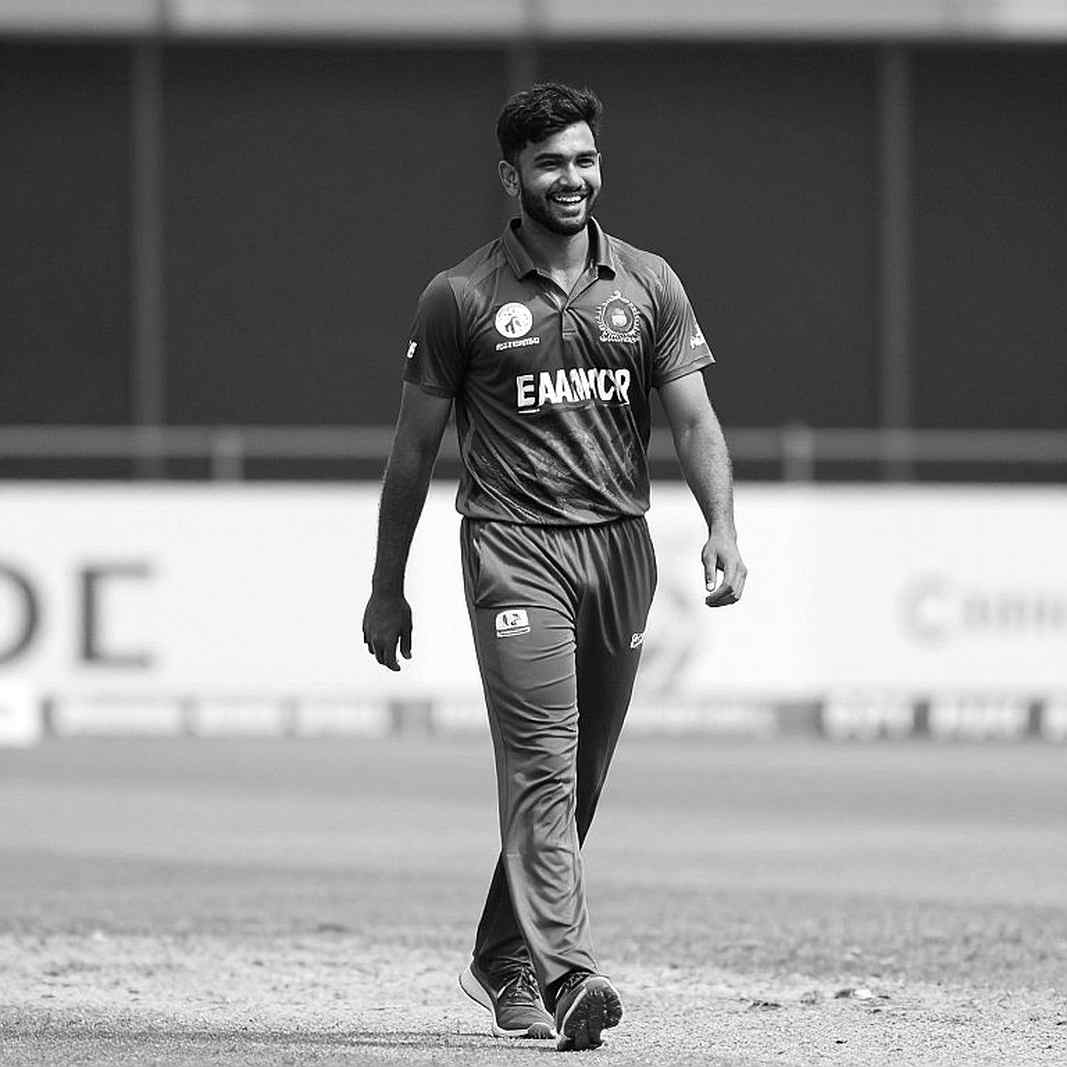
Farhan's innings was a different type. 73 runs, with his fifty off 31 balls — a strike rate near 161. The normal T20I top-order benchmark runs 130 to 150. He was above benchmark. But for Farhan the role matters more than the runs. He is the new captain and, in the same match, the side's second-highest scorer. This 'leadership-by-performance' model gives a team short-term momentum, but it carries risk — if the captain's batting form dips, the pressure returns doubled.
And the most durable signal in this match I look for not in the batting but in the bowling. Mohammad Imran's 3/11 from four overs — an economy of just 2.75 per over. On a flat track that number is rare. Because on a flat track bowlers are usually given a pass — 'the pitch belongs to the batter, the bowler can do nothing.' When someone refuses that pass and concedes 11 in four overs, there is a specific skill behind it, not luck. In Imran's description there is one line — 'a natural angle into the right-hander's body.' That is not coincidence; that is a repeatable skill. Imran's 3/11 is not an event of one match, it is an asset. Add Mirza's 2/28, and Pakistan's middle-overs control never let Sri Lanka find a 'big over.' Sri Lanka finished 133/7 — a late 50-run stand delayed defeat, it did not avert it.
Now the section without which my own accounting would be incomplete. The way an 82-run margin is being read as 'Pakistan demolished Sri Lanka' is not the full picture. Sri Lanka dropped at least three catches. One was Farhan's — off a top-edged slower ball. Suppose that catch is held; Farhan is out, and the match's momentum shifts. Perhaps the margin falls from 82 to 40, perhaps Sri Lanka chase with a little more courage.
When I read a scorecard I separate two columns: one 'control,' one 'composition.' Pakistan's 215/3 here is a composition — but it stands on just two batters. Beyond Sadaqat and Farhan, no one made a major contribution. This is a top-heavy scorecard. On a flat track, on a day when two men fire, it works; but had Sadaqat made nought and Farhan fallen early, the middle order would have faced an examination it avoided today. So 215/3 does not license the reading of a 'deep batting line-up.'
On Sri Lanka's side, the cause of defeat is catching and bowling discipline — not a lack of talent. But there is a subtle point here. Dropped catches, slot balls, failing to find 'big overs' — if we excuse these as 'bad luck,' we err. Recurring fielding failure and weak bowling patterns are a signal of a team's standard, not of its fortune. A strong side is known not by talent but by repeatable execution. Sri Lanka failed to match that, again and again.
And one thing I noted at the very start — Chameera's rest. It is either workload management or a tactical concession. Either way, Sri Lanka did not field its best weapon in this match. So the 82-run margin must be read in that context — it is not a pure talent gap. It is a compound of home venue, a rested opposition seamer, fielding failure and a flat track.
A drinks break is not a pause; it is the moment a captain rewrites the script. In this match the script was rewritten twice — once in Sri Lanka's powerplay, once in Pakistan's death overs. Both were deliberate decisions, not chance.
So what will I watch for in the rest of the series? I will not look at Sadaqat's score; I will look at two things. First, in away conditions — where there is swing, seam and safe catching — how well his boundary share holds. Second, Pakistan's middle order: if the next two matches also produce 215-type scores resting on two men, that is fortune; if the third and fourth batters take a role, that is structure. My account for Farhan and Imran is different — both have given signals that should hold when conditions change.
Sadaqat's innings is genuinely good. But when I look at a number, I ask: is it proving something, or covering something? The 96 proves that Sadaqat, today, on a flat track, can punish slot balls. It covers the fact that his true level remains unmeasured — because the best test is not a flat track, but the cricket beyond it. In the next series, when Rawalpindi's lights go out and the ball swings, we will know — is today's 96 a beginning, or an isolated flash?